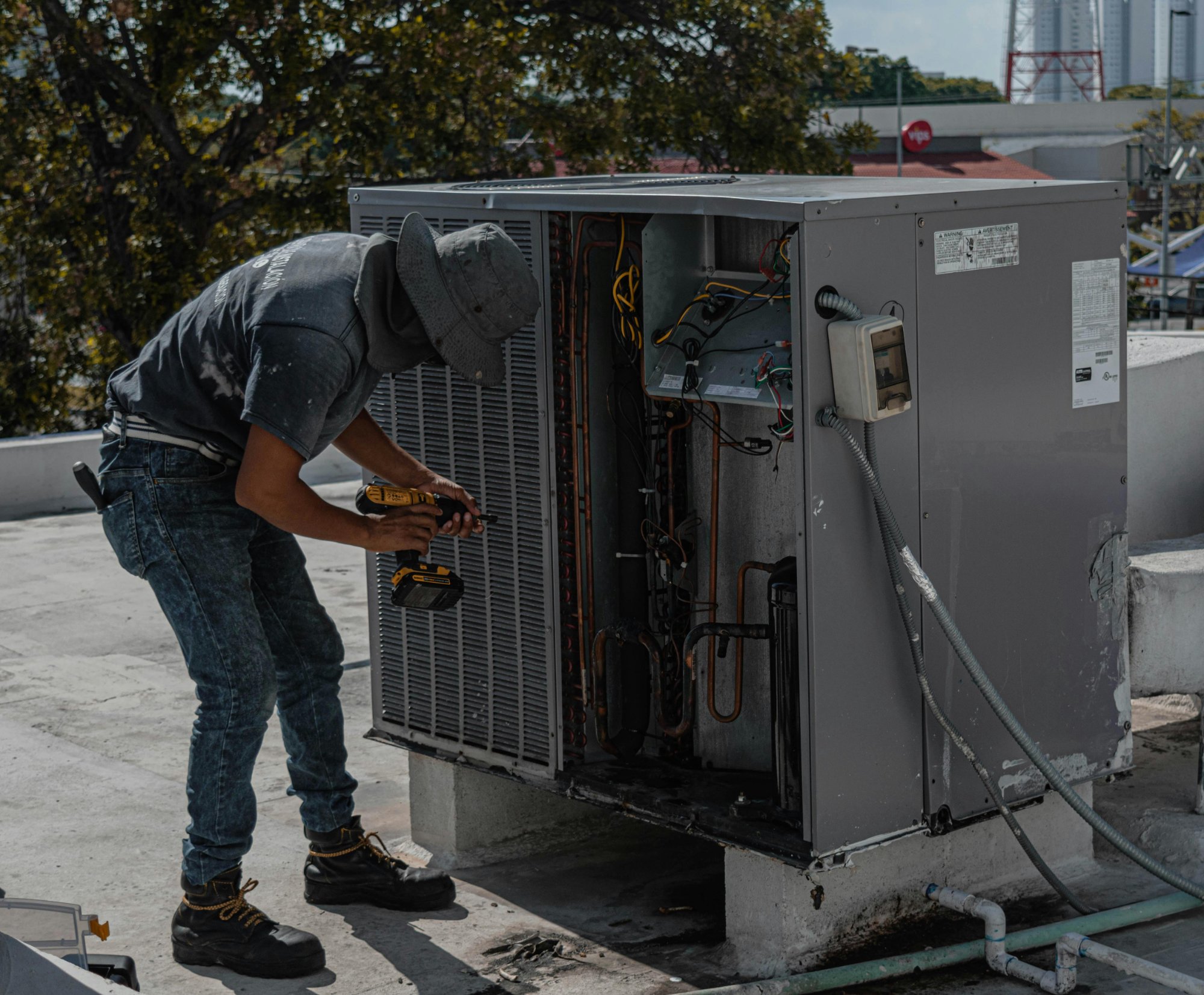

Your AC is on, air is coming out of the vents, but it's warm, or at least not cold. In a South Florida August, you have maybe a few hours before the house is genuinely uncomfortable, so let's not waste them. Here's the exact order we'd check things in if it were our house, starting with the five-minute stuff that fixes about a third of "AC not cooling" calls before a truck ever rolls.
The 5-minute checklist (do this before you call anyone)
- Thermostat first. Confirm it's set to COOL (not just ON or HEAT, it happens more than you'd think) and the set temperature is below the current room temperature. Then check the fan setting: it should be on AUTO, not ON. In ON, the blower runs even when the system isn't cooling, so the vents blow room-temperature air between cycles, which feels exactly like "my AC is blowing warm air."
- Dead thermostat batteries. If the screen is blank or flickering, swap the batteries. A dying thermostat can call for fan without calling for cooling.
- Check both breakers. Most Florida homes have two: one for the indoor air handler, one for the outdoor condenser. If the condenser breaker is tripped, the indoor fan keeps blowing (warm) air while the outdoor unit sits dead silent. Flip a tripped breaker fully OFF, then ON, once. If it trips again, stop, that's an electrical fault, leave it off and call.
- Look at the air filter. If you can't see light through it, replace it. A suffocated system loses a huge chunk of its cooling capacity.
- Walk outside and look at the condenser. Is the fan on top spinning? Is the unit humming? Is it caked in grass clippings, leaves, or cottonwood fluff? A condenser that can't dump heat can't cool your house. (While you're there: any ice on the copper lines? If yes, see the freeze-up section below.)
Most Florida systems have a safety switch that shuts cooling down when the condensate drain backs up, before the pan overflows into your ceiling. If the AC quit cooling out of nowhere on a humid week, a tripped float switch from a clogged drain line is a prime suspect. Here's how to clear the drain line yourself.
Still not cooling? Match your symptom below.
The outdoor unit isn't running at all
Indoor fan blowing, outdoor unit silent. If the breaker is fine, the usual culprit is a failed capacitor or contactor, the two hardest-working electrical parts in the system. You may hear a hum or a click as the unit tries and fails to start. These are among the cheapest, fastest repairs in HVAC, a same-day fix. It can also be a failed compressor, which is a much bigger conversation, but don't assume the worst: capacitors outnumber compressors on our failure list many times over.
Air is blowing, but it's barely cool
Vents blowing air that's "cool-ish" but the house creeps up all afternoon. In order of likelihood:
- Dirty condenser coil. Your outdoor coil's job is rejecting heat into 93° air, and it can't do it through a blanket of dirt. Gently rinse the fins with a garden hose (power off at the disconnect first, low pressure, top down). This alone restores meaningful capacity on neglected units.
- Low refrigerant from a leak. The classic signature: cooling that's gotten gradually weaker over weeks, longer run times, maybe a hissing sound, and eventually ice. Refrigerant is a closed loop, low means leaking, and it needs a pro with a leak detector, not just a top-off. On older R-410A systems this repair has gotten pricier as the refrigerant phases down, which we cover honestly in repair or replace in 2026?
- Leaky or disconnected attic ducts. If one room is warm but the rest are fine, or the system cools weakly everywhere despite a healthy condenser, your cold air may be dumping into a 130° attic before it reaches the vents.
- Ice on the coil. Ice actually blocks airflow, so a frozen system blows weak, warm-ish air. If you see ice on the lines or coil, shut cooling off and let it thaw before doing anything else, then read why ACs freeze up in summer.
It cools fine in the morning, fails every afternoon
A system that holds temperature until 2pm and loses ground until sunset is capacity-limited: an aging compressor, a slightly low charge, a dirty coil, duct losses, or a system that was undersized (or the house gained load, additions, worse insulation, more west glass). This pattern is also what "running constantly" looks like from the bill's point of view, we wrote up the runtime math and fixes in why is my AC running all day? If the system has never kept up on hot afternoons, start with sizing.
It's blowing actually-warm air, like a heater
Three main causes: the thermostat is calling for heat (or a heat pump's reversing valve is stuck in heat mode), the outdoor unit is off while the fan runs (breaker, capacitor, float switch, see above), or a bad refrigerant leak has left the system with nothing to cool with. The first one you can check yourself; the other two are a service call.
What a "not cooling" service call looks like with us
A tech runs the system, checks temperatures across the coil (we want roughly a 16-22°F drop between return and supply air), inspects electrical components under load, checks refrigerant pressures, and inspects the drain and float switch. You get a written flat-rate quote before any repair happens, and if the honest answer is that the money would be better spent on replacement, we'll say that plainly and show the math instead of patching you $600 at a time. That diagnostic process is the core of our AC repair service.
And if the checklist above got you cooling again: set a reminder to swap the filter monthly through October, and consider a tune-up, nearly every cause on this page announces itself early to a tech with gauges.
AC not cooling right now? Call (561) 503-3003 or book online. Same-day service across Palm Beach, Martin, and Broward Counties, honest diagnosis, written flat-rate quotes, 90-day warranty.