
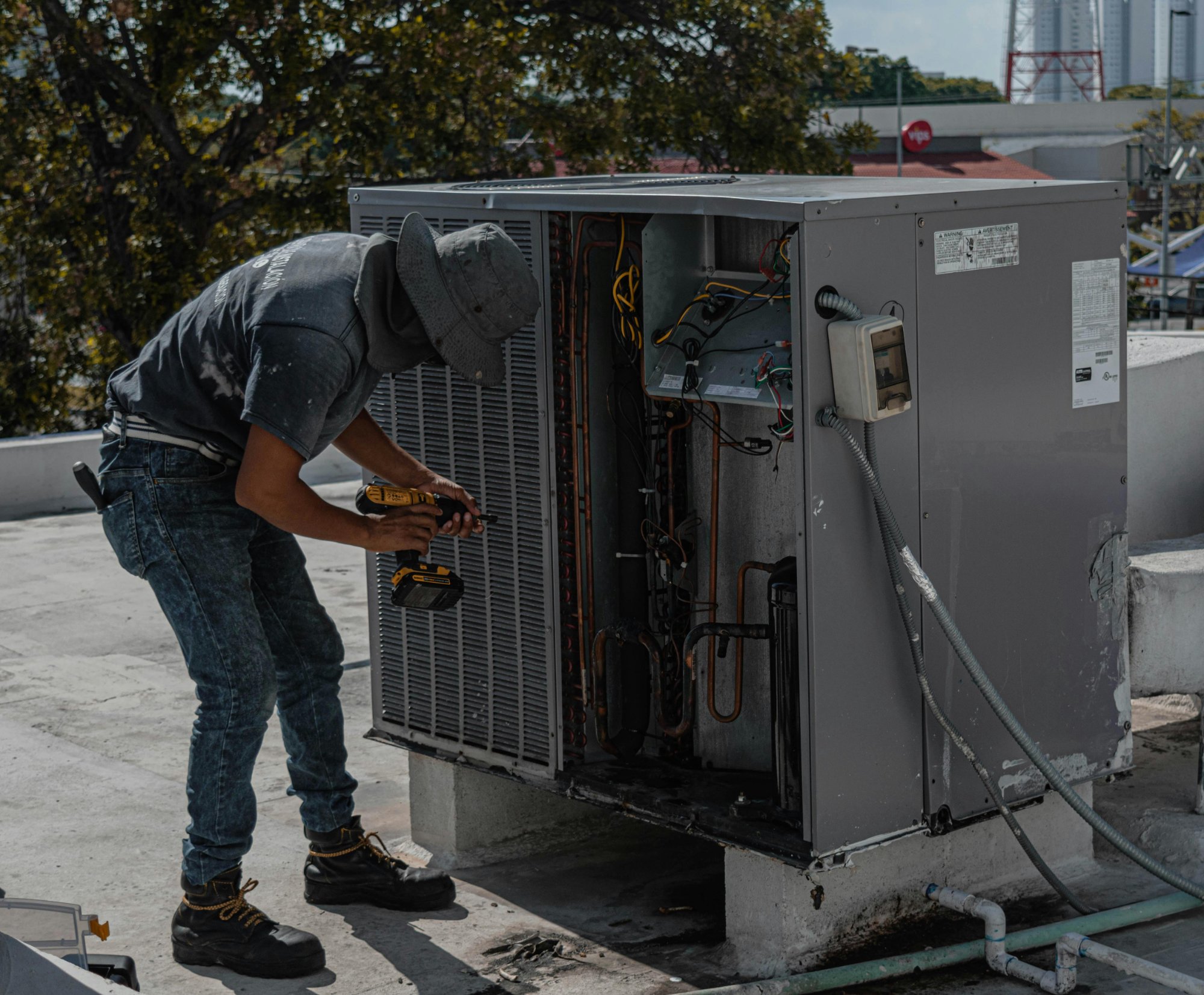
It's the worst feeling in a Florida summer. The thermostat says 78°. The thermostat is set to 72°. You can hear the air handler running. You can hear the condenser outside running. But the house is still 78°, and the air coming out of the vents feels lukewarm at best.
If you've ever Googled "why is my AC running but not cooling" while sweating on your living room floor, you're in the right place. We see this exact situation hundreds of times a year across Palm Beach, Martin, and Broward Counties. Here are the seven causes we encounter most, in roughly the order you should check them.
1. A clogged air filter (the #1 cause, by far)
About 35% of "AC not cooling" calls we run end up being a filter that hasn't been changed in six months. A clogged filter restricts airflow across the evaporator coil, which causes the coil to ice over, which blocks airflow further, which means almost no cold air reaches the rooms.
Check this first. Pull your filter and hold it up to a window or light. If you can't clearly see daylight through it, replace it. Run the system for 30 minutes with the new filter. If it's still not cooling, move on.
In Florida, where ACs run 8-9 months a year, you should be replacing 1-inch filters every 30-60 days. Pet households should lean toward 30. Media filters (4-5 inch) typically last 6-12 months. Most homes don't change filters often enough.
2. A frozen evaporator coil
The evaporator coil is the indoor coil where refrigerant absorbs heat from your home's air. When something goes wrong (low refrigerant, restricted airflow, dirty coil), the coil temperature drops below freezing and water condensation freezes solid on the coil surface. Once that happens, no heat exchange can occur, and you get warm air at the vents.
Look at your indoor air handler. If you see ice on any of the copper lines or on the unit itself, that's a frozen coil. Turn the system off (set the thermostat to OFF) but turn the fan to ON, and let it run for 2-3 hours to thaw. Then run the AC again. If it ices up again, you have an underlying problem (usually low refrigerant or restricted airflow), and you need a tech.
We wrote a full piece on why ACs freeze up in Florida summer if you want the longer version.
3. Low refrigerant charge (and probably a leak)
If the AC is properly maintained and the filter is clean but it still isn't cooling, refrigerant is the next suspect. Refrigerant is what actually moves heat out of your home. Without enough of it, the system can't transfer heat efficiently.
Here's the catch: AC refrigerant doesn't get "used up" the way gas in a car does. It's a closed loop. If your charge is low, you have a leak. Some leaks are tiny pinholes that lose ounces over a year; others are catastrophic (a connection that came loose, a damaged line set). Either way, just adding more refrigerant without finding the leak is illegal under EPA rules and will fail again, often within months.
Refrigerant work requires EPA Section 608 certification and special equipment. This isn't a DIY fix.
4. A failed run capacitor
The run capacitor is a small cylindrical component that gives your compressor and fan motors the kick they need to start and run. Capacitors fail constantly in Florida heat (they're rated for high temperatures, but Florida pushes the limits). A weak or failed capacitor makes motors struggle, run hot, and cool poorly, sometimes the compressor doesn't run at all even though everything else seems to be working.
Symptoms beyond "not cooling": a humming sound from the outdoor unit without the fan spinning, the fan starting and stopping abnormally, or a system that takes way longer to start each cycle.
Capacitor replacement is one of the most common AC repairs in Florida. It's a same-visit fix, the part is inexpensive, and it dramatically improves performance when the original was weak.
5. A dirty condenser coil (the outdoor unit)
Your outdoor unit pulls air through its coil to release heat into the outdoor air. When that coil gets coated with dirt, grass clippings, dryer lint, or salt particulate (Florida coastal homes get this badly), the unit can't release heat efficiently. The compressor works harder, the system gets hotter, and your indoor cooling drops.
Walk outside and look at your condenser. If the fins look gray, fuzzy, or matted with debris, the coil needs cleaning. You can do a basic rinse yourself with a garden hose (low pressure, water flowing from inside out, with the breaker OFF). For deeper cleaning with coil cleaner, that's a tech call.
6. An oversized AC that short-cycles
This one's controversial because it sounds backwards. An AC that's too big for the home will cool the air to setpoint quickly, then shut off. It hasn't run long enough to dehumidify properly, so the house feels clammy even when the temperature reading is low. And short-cycling like this stresses the compressor.
If your AC is brand-new and was just installed, and it cools fast but the humidity stays high, this is a sizing problem, and it's the most expensive mistake in Florida HVAC. The right fix is sometimes a thermostat with longer cycle settings; sometimes adding a whole-home dehumidifier; sometimes (worst case) replacing the system with one properly sized to your home's actual load.
7. A failing compressor
The compressor is the heart of your AC, the pump that moves refrigerant through the system. Compressors are built to last 12-15 years in normal use, but Florida's duty cycle is rough on them, and they're often the part that finally calls it quits on an aging system.
Symptoms: the system runs but produces little or no cooling; you hear unusual sounds (clicking, grinding, or a hard hum) from the outdoor unit; the breaker trips repeatedly; the unit starts then immediately stops.
Compressor replacement is the most expensive single AC repair, and on a system that's 10+ years old, it's often the moment to weigh repair vs. replacement seriously. We always quote both side-by-side so you can decide. Read our framework on repair or replace if you're at this point.
What to do right now
Before calling anyone, run through this 5-minute checklist:
- Confirm thermostat settings. Set to "Cool," temperature setpoint below current room temp.
- Check the filter. Replace if you can't see daylight through it.
- Look at the indoor unit. Any ice = stop and call us.
- Look at the outdoor unit. Is it running? Is the coil dirty? Are leaves and grass piled around it?
- Check breakers. Confirm none have tripped on the AC circuits.
If those don't fix it, you need a real diagnostic. We service Palm Beach, Martin, and Broward Counties with same-day visits, written flat-rate quotes, and 90-day warranty on all repairs. Call (561) 503-3003 or request a visit online, a real person picks up.