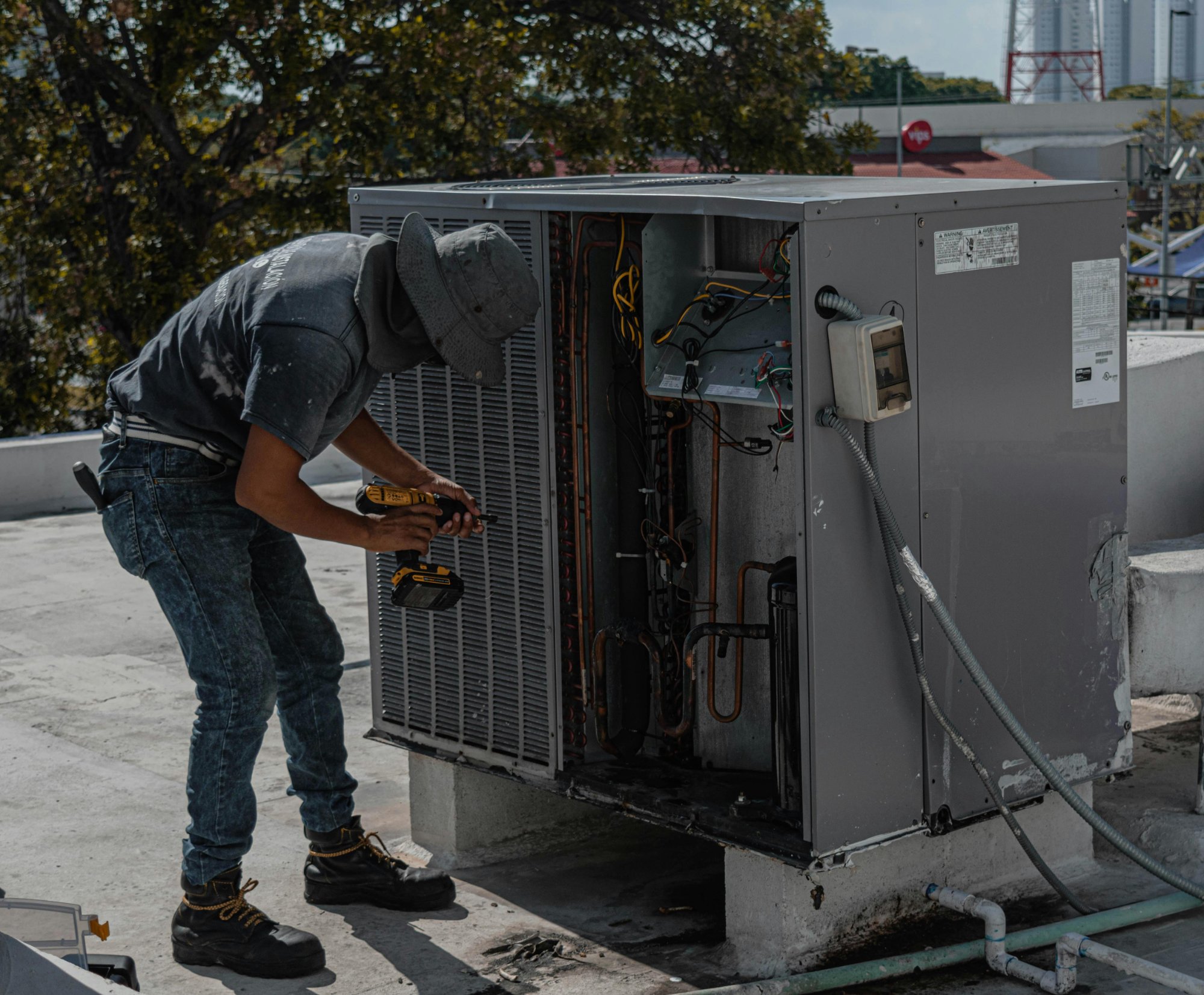

Here's a fact most Florida homeowners don't know: your AC pulls between 5 and 15 gallons of water out of the air every single day during summer. All that water has to go somewhere, and where it goes is a small PVC pipe called the condensate drain line.
When that drain line clogs up (and in Florida, it eventually will), the water has nowhere to go. It backs up. It overflows. It drips through your ceiling. And the AC, sensing the problem, shuts itself off, leaving you sweating in a humid house.
Drain-line clogs are the #2 cause of Florida AC failures we see, second only to capacitor failures. The good news: many of them are DIY-fixable in about ten minutes.
How to tell your drain line is clogged
Symptoms, in roughly the order they appear:
- Standing water in the drip pan beneath your indoor air handler (the secondary pan)
- Water dripping from the air handler onto the floor, ceiling, or attic insulation
- The AC shuts itself off and won't restart (because a float safety switch tripped, or the system is detecting a problem)
- Musty smell from the vents (because the standing water is breeding mold)
- Visible water stain on the ceiling below an attic-mounted air handler (this means it's been overflowing for a while, not good)
How to clear a clog yourself
Method 1: The vinegar flush (works ~80% of the time)
This is the simplest method and works for most early-stage clogs (algae, mold, light biofilm).
- Find the drain access port. Near your indoor air handler, look for a PVC pipe with a T-fitting or a screw cap on top. That's the access port. It usually sits a few inches above the drain pan.
- Remove the cap. Hand-tight, no tools needed.
- Pour in 1 cup of distilled white vinegar. Slowly. Some homeowners use bleach, but bleach can degrade PVC over time, vinegar is gentler and works just as well on biological clogs.
- Replace the cap. Wait 30 minutes.
- Flush with water. Pour a couple cups of water through the same access port. Listen for it draining. Walk outside and look at the drain line outlet (usually near your foundation or a wall), water should be running out.
If water comes out the outdoor end, you're done. Run the AC normally and watch the drain pan over the next day to make sure no water is backing up.
Method 2: The wet/dry vacuum suck (works for tougher clogs)
If vinegar doesn't fix it, the clog is probably further down the line. You need to physically pull the clog out, and a wet/dry vacuum (Shop-Vac type) does this better than anything else.
- Find the outdoor drain outlet. Look for a PVC pipe sticking out of the side of your house, usually near the foundation, often near the air handler's exterior wall. It's typically white PVC, about 3/4 inch.
- Wrap the vacuum hose against the outlet. Use a rag or duct tape to make a tight seal between the vacuum hose end and the drain outlet. The seal matters, leaks reduce suction.
- Run the vacuum for 2-3 minutes. You should hear and feel water moving. The vacuum will pull water (and the clog) out of the line.
- Verify. Check the indoor drain pan, it should drain freely now. Pour water into the access port, it should flow through within seconds.
If neither method works, or if your air handler is in the attic and you're seeing ceiling stains, stop and call a tech. The clog is likely deep in the line, and DIY methods could push it further.
The $40 upgrade that prevents ceiling disasters
Even if you keep up with vinegar flushes religiously, eventually a clog will happen, that's just Florida. The question is whether it costs you a 10-minute fix or a $4,000 ceiling repair.
The answer is a condensate float safety switch. It's a small device that sits in the drain pan or in the drain line itself, and it shuts off the AC the moment water levels rise above normal. Cost: about $40 in parts, 30 minutes of installation. Most modern systems should have one, but many older Florida systems don't, especially if the system was installed before 2005 or by a budget contractor.
We install float switches on every new install and on every tune-up where the existing system doesn't have one. It's the highest-ROI single upgrade you can make to a Florida AC.
If your air handler is in the attic above living space (very common in Florida), a float switch is non-negotiable. The cost difference between a $40 switch and a ceiling repair is the easiest math in HVAC.
How to keep this from happening
Three habits that prevent 95% of drain-line clog calls:
- Quarterly vinegar flush. One cup, every three months. 90 seconds of work. Set it on a calendar.
- Twice-yearly professional tune-up. A spring and fall tune-up includes a full drain-line flush with nitrogen (more thorough than vinegar) and an inspection of the drain pan, float switch, and pan integrity.
- UV-C light at the coil. A UV-C lamp installed at the evaporator coil sterilizes biological growth at the source, before it ever reaches the drain line. Dramatically reduces clog frequency. Standard on our Indoor Air Quality upgrades.
If you've got a clogged drain line you can't clear, or you want a float switch installed, or you'd just rather have someone professionally handle the maintenance, that's us. (561) 503-3003 or request a visit online. Same-day service across Palm Beach, Martin, and Broward Counties.